
Capital Gains Tax Property Valuations
Independent Property Valuations for Capital Gains Tax
ValuConsult provides independent property valuations for Capital Gains Tax (CGT) purposes across Melbourne and Victoria. We undertake both current and retrospective property valuations, including valuations where the market value of a property is required as at an earlier date for CGT purposes.
When Is a Property Valuation Required for Capital Gains Tax?
A property valuation may be required for Capital Gains Tax purposes where the market value of a property needs to be established at a particular date. This may arise when a former main residence is first used to produce income, in certain deceased estate or inherited property circumstances, where a property is transferred other than at market value, or in other situations where market value is relevant for CGT purposes.
In many cases, the required valuation date may be several years in the past. ValuConsult can undertake a retrospective property valuation to assess the Market Value of the property as at the relevant historical date.
The appropriate valuation date and CGT treatment should be confirmed with your accountant or tax adviser. ValuConsult's role is to provide an independent assessment of the property's Market Value as at the instructed valuation date.

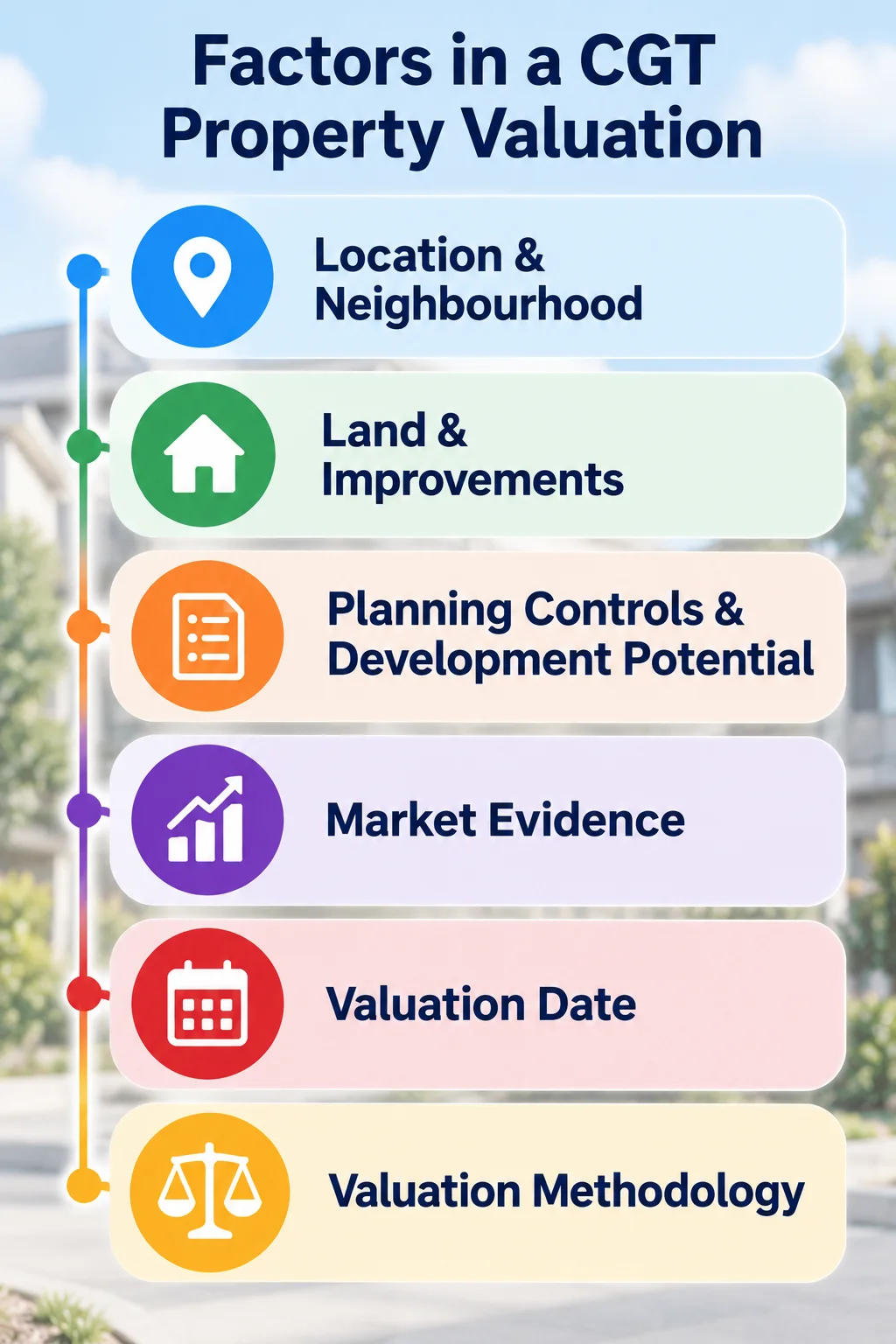
Common Situations Where a CGT Property Valuation May Be Required
A property valuation may be required for CGT purposes in a number of circumstances where the Market Value of a property needs to be established at a particular date, including:
Retrospective Property Valuations for Capital Gains Tax
In many CGT matters, the relevant valuation date may be several years, or even decades, in the past. A retrospective property valuation assesses the Market Value of a property as at a specified historical date rather than its current value.
ValuConsult undertakes retrospective property valuations using historical sales evidence, market conditions and available information concerning the property as at the relevant valuation date. This may include researching comparable sales and other market evidence from the period concerned.
Retrospective valuations can be prepared for residential, commercial, industrial, retail and other property types where a historical Market Value is required for CGT purposes.

CGT Changes from 1 July 2027
From 1 July 2027, significant changes to Australia's Capital Gains Tax arrangements will apply, as outlined in the relevant legislation. For relevant taxpayers and assets, the existing 50% CGT discount will generally be replaced by cost base indexation for gains accruing from that date, together with a minimum 30% tax rate on real capital gains, subject to applicable exemptions and transitional provisions.
For assets held before 1 July 2027 and disposed of after that date, transitional arrangements provide for gains accruing before and after the commencement date to be treated separately. Depending on the applicable provisions, the market value of the asset at the transition date may be established through a valuation or determined using a prescribed apportionment method.
Where a property valuation is appropriate, ValuConsult can provide an independent assessment of Market Value as at 1 July 2027 for CGT purposes. Property owners should seek advice from their accountant or tax adviser regarding the applicable CGT treatment, transitional provisions and whether a valuation is required or appropriate in their circumstances.
CGT Cost Base and Property Valuation
The cost base of a property is generally relevant to the calculation of a capital gain or loss and may include the purchase price and certain other acquisition, ownership, improvement and disposal costs, depending on the applicable tax rules.
A property valuation does not determine the cost base or the amount of Capital Gains Tax payable. However, where the CGT provisions require the property's market value at a particular date, an independent valuation may be required to establish that value.
Property owners should obtain advice from their accountant or tax adviser regarding the applicable cost base, CGT treatment and required valuation date.
Example: Retrospective Property Valuation for CGT Purposes
A common situation arises where a property was originally acquired and occupied as the owner's main residence and was subsequently converted to an income-producing property.
Depending on the applicable CGT provisions, the property's Market Value at the date it was first used to produce income may be relevant for calculating a future capital gain. Where that date occurred several years ago, a retrospective property valuation may be required.
For example, if a property owner moved out of their home and first rented the property on 1 July 2018, but sold it several years later, their accountant or tax adviser may require the property's Market Value as at 1 July 2018. ValuConsult can undertake a retrospective valuation using historical sales evidence and other market information relevant to that valuation date.
The appropriate CGT treatment and valuation date should be confirmed by the property owner's accountant or tax adviser.
A retrospective valuation considers the property's characteristics and the market evidence available at the relevant historical date. Subsequent changes in property prices, improvements or market conditions do not automatically represent the property's Market Value at that earlier date.
Frequently Asked Questions About CGT Property Valuations
Do I need a property valuation for Capital Gains Tax?
Not in every case. A property valuation may be required where the applicable CGT provisions require the Market Value of the property to be established at a particular date. Your accountant or tax adviser should confirm whether a valuation is required and the appropriate valuation date.
Can a property be valued retrospectively for CGT purposes?
Yes. A retrospective property valuation can assess the Market Value of a property as at an earlier date. This may be required where the relevant CGT valuation date occurred several years or even decades ago. The valuation is based on historical market evidence and available information concerning the property as at that date.
Do I need a property valuation as at 1 July 2027?
Not necessarily. Under the transitional arrangements for the CGT changes commencing on 1 July 2027, the value of certain assets held before that date may need to be established. A property valuation is one method that may be used to establish the value, with an alternative prescribed method also available. Property owners should obtain advice from their accountant or tax adviser as to which method is appropriate.
What information is required for a retrospective CGT property valuation?
The information required will depend on the property and valuation date, but may include the property address, relevant valuation date, title details, historical plans or photographs, details of improvements or renovations, and any other information describing the property as at that date. ValuConsult will also research relevant historical market evidence.